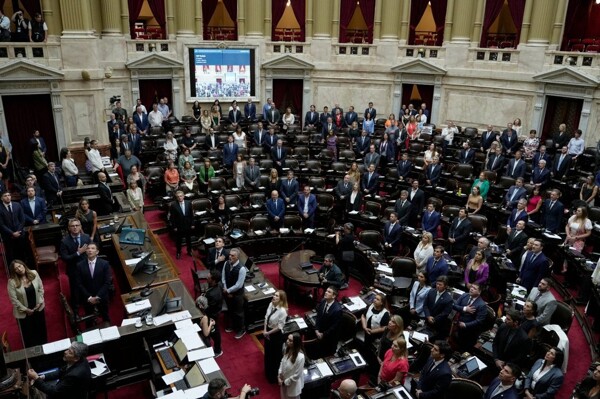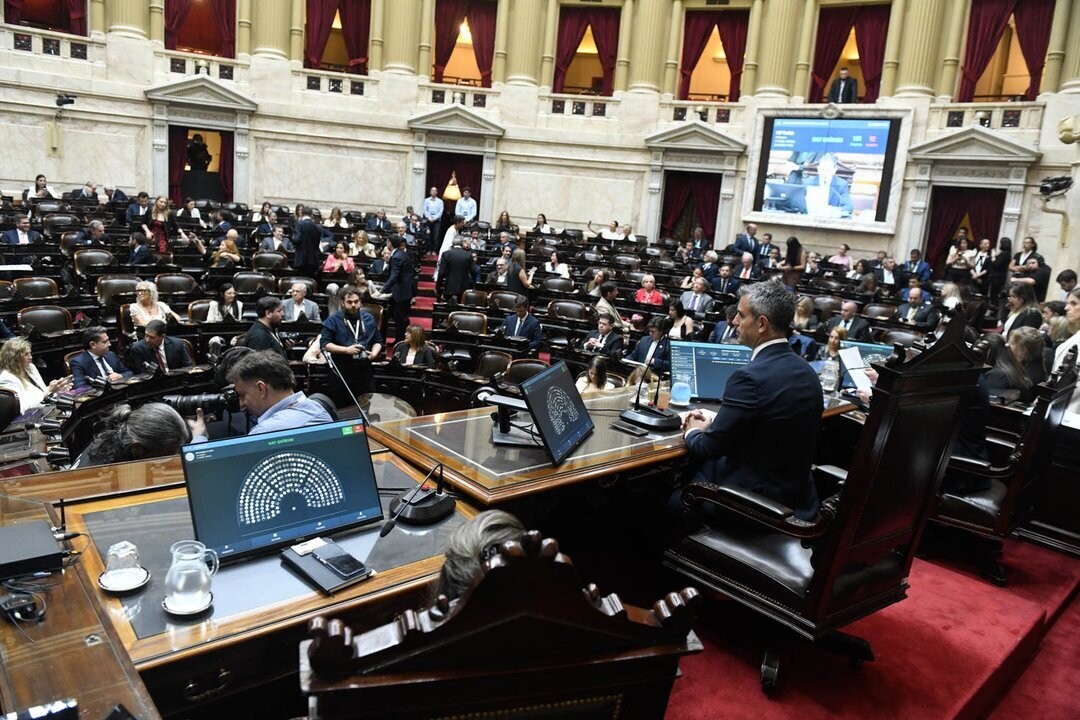
This morning, the Chamber of Deputies of Argentina began a special session to consider a bill creating a new Juvenile Criminal Code, which lowers the age of criminal responsibility from 16 to 14 years. Following this, a vote will be held on the ratification of the trade agreement signed between Mercosur and the European Union. At the start of the session, a tribute was paid in the chamber to former national deputy for Chaco Sandra Mendoza, who passed away on Wednesday at the age of 62. Also present in the chamber was former Córdoba Governor Juan Schiaretti, who was sworn in as a national deputy (United Provinces) after being elected in the elections on October 26th. The quorum for the session was reached with the deputies from La Libertad Avanza, PRO, UCR, Federal Innovation, Independence, and Elijo Catamarca, as well as some other monoblock legislators.
The President of the Juvenile Criminal Legislation Commission and the majority report's presenter, Laura Rodríguez Machado, stated that the bill's intention is not to "amass minors deprived of liberty in institutions" but to "resocialize them." The report contemplates a number of alternative penalties to prison, but there is also the possibility that for crimes punishable by 3 to 10 years in prison, judges may opt for these alternative measures to imprisonment, unless the victim's death was involved. "They told us that from now on we want to imprison everyone, that the solution is not to put minors in prisons. It's a lie. I don't know what figures they gave me," she noted.
"With this majority, we will work to ensure that the final function of these institutions is to resocialize the minor," pointed out Rodríguez Machado. For her, "there are many who do not want to change anything so that everything remains the same." "One of the arguments is 'do nothing' because the percentage of minors in conflict with the law who commit crimes is very low. We are taking responsibility for that," she ratified.
According to Tolosa Paz, "this problem is not solved with marketing slogans, changing the age of criminality every 24 hours as if it were a poker game, but with political responsibility." "They just brought a terrible project, they are not going to solve the problem, and Argentina after 45 years needs a juvenile criminal regime with a different perspective, with a State that does not look the other way. No figure can hide impunity in Argentina," she stated. In the view of the ruling party's deputy, "even with a single case of a terrible death, the State must have the power to act accordingly." "Another of the arguments is that we are coming to criminalize the kids. More seriousness, less marketing, and fewer slogans," she concluded. In addition to the controversial lowering of the age of criminal responsibility to 14, the special regime for minors proposed by the ruling party proposes a range of sanctions or alternative punishments to deprivation of liberty, establishes that minors must not be mixed with adults in places of detention, and includes complementary measures for resocialization. The bill rules out the possibility of a life sentence and sets a maximum of 15 years in prison for minors. For crimes with sentences of less than 3 years, prison sentences are discarded, while for sentences of between 3 and 10 years linked to crimes that have not caused death or serious injuries, other types of social and educational-focused sanctions are prioritized.
On the other hand, the report incorporates a change demanded by the dialogueists from the Government, which is the funding to effectively apply the juvenile criminal regime: more than 20 billion pesos will be allocated to the Public Defender's Office and more than 3 billion pesos to the Ministry of Justice.
"Notice the cruelty of that statement because we are in a new Argentina. I don't think there is a more cruel argument than that," she considered. "If I have to tell the victims of these crimes that the State is not going to do anything because there are not enough victims yet, because it is not enough with the dead we have now, with the families that have lost people, with those who are robbed every day, we are giving guarantees of due process," she affirmed.
In turn, the national deputy for Unión por la Patria, Victoria Tolosa Paz, strongly criticized the La Libertad Avanza senator Patricia Bullrich for launching "a marketing campaign saying 'adult crime, adult penalty'. "It may serve for an election campaign but it moves away from what we have to do those of us who have the responsibility to move this country forward," she emphasized. As the minority report's presenter for UxP, the Buenos Aires deputy highlighted that the peronist proposal considers that "adolescents will be punishable between the ages of 16 and 18 and the maximum penalty will be 10 years." "It is based on a proportional, differential penalty with a system that will judge them, defend them and give them a way out based on the Constitution. Today the current regime that many do not want to modify or ever change allows the adoption of vague restrictive measures," lamented the Córdoba deputy. "Today that happens except in some provinces that have particular regulations.